Optimizing human-machine combinations
AI is rapidly transforming how we live and work, and its implementation is becoming increasingly prevalent across industries. According to our 2024 research report, 94% of executives believe AI will have a positive impact on their industry. From healthcare and finance to manufacturing and transportation, AI enables us to automate routine tasks, augment human decision-making, and create new opportunities for innovation and growth.
However, to fully realize the potential of AI, we need to understand the nature of the jobs and tasks involved and how they can be optimized through a holistic framework that considers both human and machine capabilities. This requires a deep understanding of the specific contexts in which AI is deployed and the skills and expertise needed to design, develop, and deploy AI systems.
People’s jobs will not disappear because of the rise of AI and automation. Instead, the impact of these technologies will transform the nature of employment and create new opportunities for people.
This will enable people to collaborate with AI and automation to achieve better outcomes. They allow us to work more efficiently and effectively, creating new opportunities for innovation and growth.
The change is happening. To adapt and respond, we must understand the work better than ever. The future operating models shaped by AI will be characterized by:
- Efficiency: AI will enable organizations to automate specific tasks and reduce the time and cost of completing them. This will ultimately result in greater productivity.
- Agility: AI can help businesses quickly adapt to changing market conditions and customer preferences, allowing them to remain competitive and relevant.
- Personalization: AI can enable businesses to personalize their offerings to individual customers based on their preferences and behavior. This will result in more satisfied customers and increased loyalty.
- Data-driven decisions: AI can enable organizations to analyze large amounts of data in real time and make more informed decisions based on the insights gained.
- Human-machine combination: There will be increased collaboration between humans and machines.
What does an operating model look like in future organizations augmented by AI?
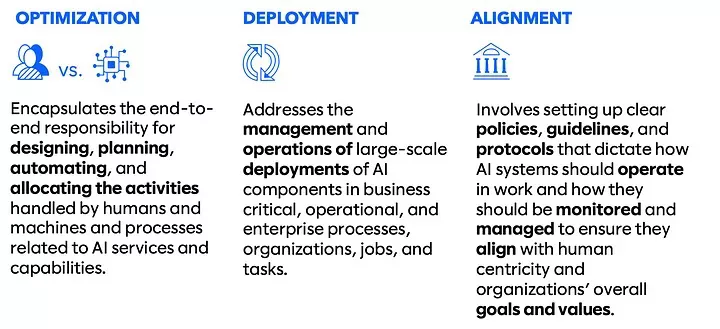
AI-augmented jobs have collateral effects on other jobs and affect the organizations’ internal operating mechanisms. Organizational leaders must consider the implications of introducing AI into their workflows and plan for holistic changes. Any AI implementation efforts should address these key questions:
- How can we identify or predict how job and work-level changes affect the larger organization?
- How should we organize work by reconfiguring human-machine interactions?
- How do we govern optimized human-machine interactions?
Understanding the nature of the jobs and tasks
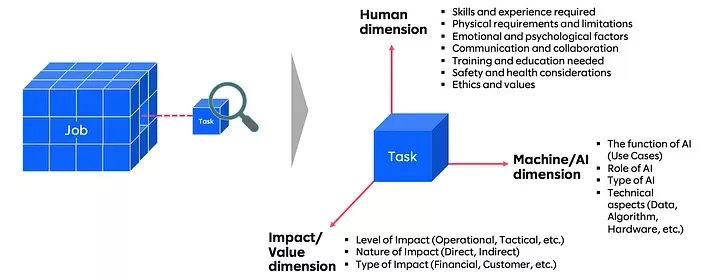
Jobs are the containers of the tasks that determine the overall outcomes.
A task has three key dimensions: human, machine (AI), and business impact/value.
The machine dimension has been a pivotal aspect of human progress since the advent of the first Industrial Revolution. Throughout history, we’ve been leveraging machines and tools to augment our productivity, increase our speed and quality, and reduce errors, but the extent of their intelligence was limited. However, the landscape is about to undergo a paradigm shift, and the role of machines will evolve into something unprecedented over the next few decades. The forms and the nature of the jobs and tasks will change dramatically.
Optimizing human-machine combinations will be at the work level; in other words, at the task level. To optimize human-machine combinations, we should start at the task level.
AI is not an autonomous sentient being that wanders among us like T-1000 or R2-D2, capable of independently completing tasks end to end.
Instead, AI can take over specific tasks from jobs, which can lead to the substitution or augmentation of human capabilities and capacities. However, this transformation has far-reaching consequences, as it alters the form and nature of jobs and introduces new complexities to the interactions between other jobs in the ecosystem.
Let’s look at these sample tasks below.
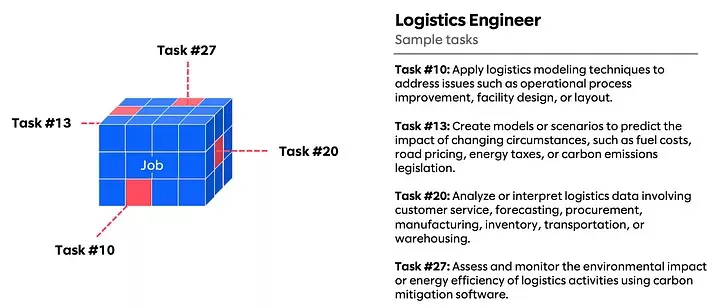
We will quickly identify their characteristics if we carefully examine the sample tasks. Let’s focus on the “verbs.”
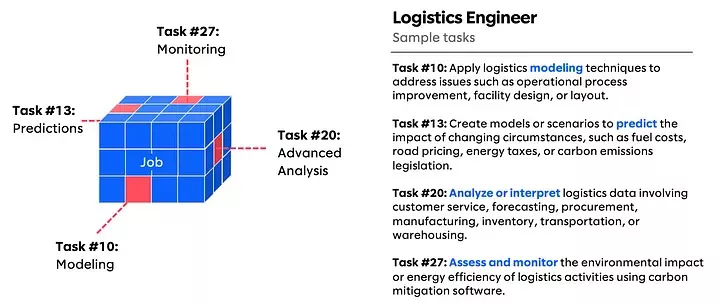
Once we have identified the nature of the jobs and tasks, we can evaluate potential human-machine optimization scenarios.
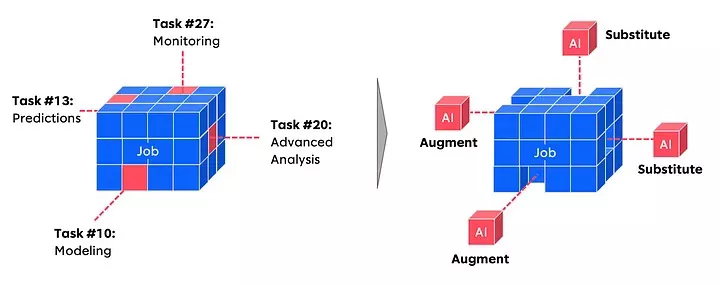
Let’s return to where we started: AI will take over some tasks from the jobs and shape their forms, natures, and interactions with the other jobs and parties.
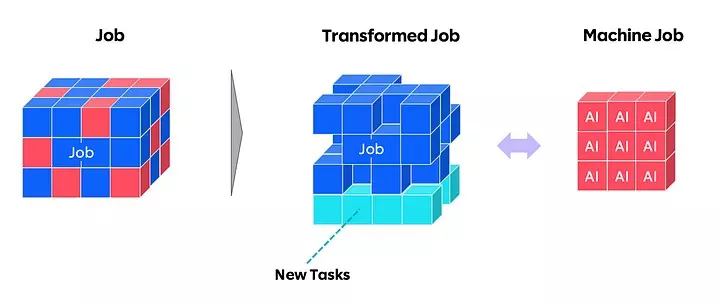
Evaluating optimization scenarios requires a consistent framework, and we need to address these key questions:
- What is the context of the work?
- What is the nature of the job?
- How should we segment jobs?
- What are the attributes of the tasks?
- What level of impact do the tasks create?
- What are the types of impact of the tasks?
- What are the complexity levels of the tasks?
- What is the interdependency level of the tasks?
- What are the use cases for AI? What should technology do?
- What role can AI take?
- What type of AI should be implemented?
- What is the prioritization model for human-machine optimization?
In this transformation journey, we must remain attentive to our overall organizational goals and values, as well as the diversity and inclusivity of our workforce. It’s crucial to measure the financial, operational, and human impacts regularly, continually refining our approach to ensure the successful integration of AI and fostering a work environment that thrives on human-machine collaboration. As we navigate this new landscape, our ultimate goal is to enhance the value our organizations provide and, in doing so, redefine the future of work.
This blog post was originally published here.